Digitising Public Art
How can we bring NUS's public art to more people through a website?

What An independent research course at the National University of Singapore
Who Student designer, writer & researcher (Me)
What I Did Conducted academic and field research to outline the content and delivery of the platform
+ Conceptualised a virtual platform to tell the story of NUS's public art, and created an interactive prototype to illustrate the concept
Results A proposed design for a platform exploring public art in NUS, and an A grade for the course
Walking around NUS, I often crossed a sculpture of a man and a boy pointing at a bird. The accompanying sign offered their names, but gave little information on who they were and why the work was there. Online, information was sparse, too.
I thus decided to embark on an independent project to make a platform that gave curious onlookers a way to find out more about the art we had in NUS. A professor supervised the project, but I was given the freedom to ideate as I pleased.
Problem + Background
– digitising cultures and bringing them to people through the internet
While public art is physically visible in the public space, the limited available information on these works has limited their visibility in terms of awareness.
This independent research project seeks to draw attention to public art in NUS, by conceptualising an interactive digital platform to introduce this culture in an engaging and informative way. This project involves both a theoretical discussion about public art culture, but also presents an interactive Figma prototype as a proof of concept for such an idea.
Academic & Field Research
– finding out more about NUS's public art collection
While NUS has an extensive collection of public artworks across its campus, there is little available information online about where these works are, much less what they are about.
Presently, there are only a few websites from NUS Museum and NUS Centre for the Arts that touch on the University's public art collection. However, they provide little information on the works themselves, touching only on the University's approach to public art, and how one could commission a public artwork.
Pictured right: NUS websites talking about the public art collection, which was a lot of words and sadly not much art


Talking to NUS's Art Authorities
To find out more, I contacted NUS Museum and NUS Centre for the Arts (CFA) to enquire more about the University's public art collection. Each department then sent me a different document containing public artworks that fall under their respective jurisdiction. Both departments also confirmed that there was little other information online that shared about these works.
Pictured right: the two separate documents sent by NUS Museum and NUS CFA
Each document carried information about public art, but it only offered limited information and carried information about art that fell under the jurisdiction of each department


Taking a art walk
NUS Museum also made the suggestion for me to walk around campus to learn more about the artworks. This allowed me to learn the names and artists behind the different artworks.
Yet, I learnt little else about the meaning of the works and the context surrounding them, leaving me with more questions than answers about the University's collection of public art.
Pictured right: the sculpture of the man and the boy, along with the accompanying sign


Theoretical academic research
To decide what information would be helpful and important to include in the platform, I conducted theoretical research to understand the topic better. Being an academic research project, this project also delves deeper into the theoretical understanding of public art in general, outside of the case study of NUS.
This theoretical background also served as the main guide for the content and presentation of the website, as opposed to a more conventional user research.
Pictured right: slides highlighting a key idea I hoped to show through the platform
The research pointed out that a common misunderstanding was that public art is just art found in public locations. However, the works also engaged with the specific places they are in, and the people who see them – these were the two dimensions I wanted to highlight.


Ideate – translating theory into use cases
Having identified the key ideas about public art to be presented on the platform, I set out to outline the specific Use Cases and map out the intended User Flow of the platform.
Use Cases & Featured
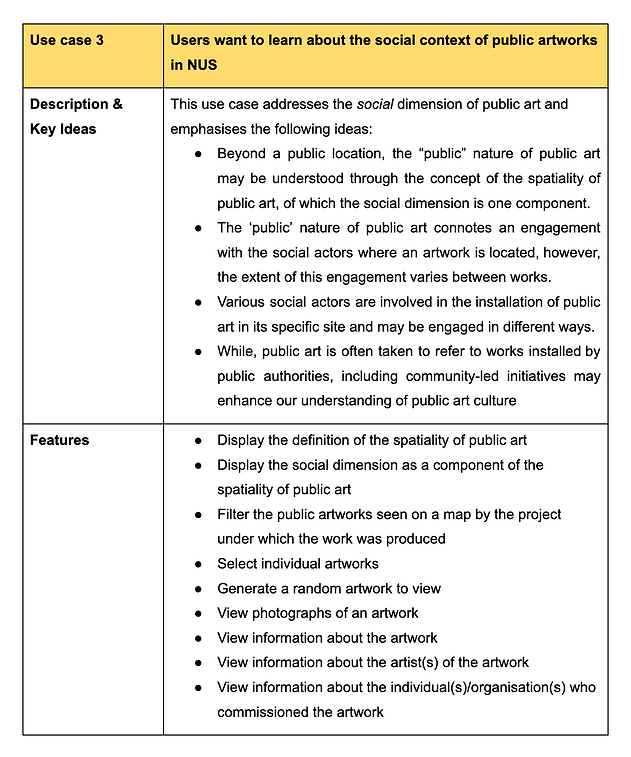
The conceptual design of the digital platform is guided by three use cases, which each identifies a specific goal that users may achieve on the website.
The use cases have been structured to each highlight one of the three dimensions of public art. Together, these use cases showcase the different approaches to public art, allowing users to understand the various facets of this culture. A series of functions required by users to achieve the use case is also outlined. The use cases and their associated features on the digital platform are summarised in the following tables..
Pictured right: tables with the three use cases


Platform Architecture & Requirements
With the use cases and features in mind, I then proceeded to outline the architecture of the platform and where features would go. This resulted in the creation of two distinct sections of the website, across which features for each use case will be implemented:
Interactive Map - The Map will allow an exploration of NUS's collection of public art. It will offer an exploratory page where users can view a map of the NUS Kent Ridge campus and view the locations of public artworks found on campus. On the page, users can also select individual artworks to learn more about them.
Interactive Story - The Story will introduce the theoretical framework behind public art in NUS. It'll illustrate this through a linear story introducing the different dimensions of public art, and serves to accompany the exploratory Interactive Map.
User Flow
To consolidate the overall flow of the platform, I created a user flow diagram to illustrate the possible ways in which the user can interact with these two pages.
Pictured right: the user flow diagram

Wireframes
The user flow diagram was subsequently translated into wireframes to quickly and simply visualise the different pages of the platform and the features available on each page.
Pictured right: wireframes for the interactive map and story

Prototype – bringing the concept to life
With the digital platform conceptualised using the user flow diagram and wireframes, I proceeded to create an interactive prototype of the platform. The designing and prototyping of the platform was done on Figma, which provided a means to flexibly and quickly iterate on the platform’s design within a short duration.
Informal User Testings
In conceptualising the platform, the various screens underwent various iterations. These iterations where informally tested with 4 students in NUS to gather insights on what information users picked up from the design. Through these informal tests, the platform was slowly shaped towards its final state.
Pictured below: an example of iterations of individual artwork pages in the Interactive Map
The element that underwent the most changes were the Individual Pages featuring each of the artworks. The changes largely lied in how the page was to engage with the 'spatiality' of the works. Here were some of the different iterations of the page.
The informal user testings revealed insights about how users would typically interact with the page. For example, a few users gave feedback that they were unlikely to spend a large amount of time reading the page and would prefer smaller bite-sized information that were more easily digested. As such, most of the users were inclined towards Version 1 of this feature, especially the quick overview it provided within the Interactive Map itself, without having to click into a separate page.
Users also provided positive feedback about the concealing mechanism in Version 2, and how it piqued their interest to further interact with the page and think about why it revealed the information when it did. Upon further explaining the rationale for the mechanism, they did mention that it would be helpful to have this rationale explained in the platform.
This informal feedback offered valuable insights that eventually shaped Version 3 of this Individual Page feature, which combined both the brevity of Version 1 and the mechanism of Version 2.


Key Features
Use Case #1 – Users want to look for the locations of public artworks in NUS.
Interactive Map with Coloured Markers – to indicate where public artworks are found across the NUS Kent Ridge Campus, coloured according to the projects that led to the installation of the work.
Interactive Story with scrolly-telling visuals – comprising different pages for each dimension and various interactive elements. This format guides users through the conceptual basis of the digital platform in a visually engaging way and illustrates ideas like how public art isn't just about the public location

Use Case #2 – Users want to learn about the spaces where public artworks are found in NUS.
Individual pages – to allow users to explore each public artwork and its associated details, including the name of the space it is in and more contextual explanations of the space's significance.
Hidden Artwork/Space Visuals – Users will be prompted to view the artwork while reading about its environment and artist, and view the space while reading about the artwork, creating an interplay of the spatial and social dimensions of the artwork.

Use Case #3 – Users want to learn about the social context of public artworks in NUS
Filters – to introduce users to the different social groups responsible for the public artworks, but also to introduce the nuance of how the works were installed by different organisations across campus.
Giving context to the Filters in the Interactive Story – the Story offers more details on the different social groups highlighted by the Filters, prompting users to draw connections between the theoretical framework of the platform and the interactive map while they explore different public artworks


Concluding Thoughts – limitations and room for further exploration
Given the limited timeline for this project, alongside the focus on exploring the discourse surrounding public art, there was limited opportunity for more iterations of the platform design. However, in the future development of this project, more exploration could be done into making use of the digital format.
New ways of representing the public artworks may be explored, for example through audio, video or even 3-dimensional graphics. While the conceptualised platform was in the format of a 2-dimensional website, exploration could even be done into creating a tool that utilises augmented reality, allowing for the website’s contents to be presented alongside the artworks in real life. With this, the platform could afford a more immersive experience of the artworks around campus, and further demonstrate the potential of digital tools as a means of presenting a culture to an audience.
While this project was exploratory and focused a lot more on theoretical content rather than usability, I got the chance to work on other projects that focused more on the user experience side of things too – check it out below:
UX Design, UI Design, Prototyping
